There’s a particular kind of confidence that comes from knowing what to do when something goes wrong.
It isn’t the confidence of thinking you can replace a doctor. It’s much simpler than that.
It’s knowing where the first-aid supplies are. Knowing which symptoms mean “wait and see” and which mean “get professional help immediately.” Knowing how to respond calmly when someone gets a burn, cuts themselves, develops a fever, has a bad toothache, or suddenly feels unwell while the nearest medical facility isn’t immediately accessible.
I started thinking about this differently after realizing how much of our everyday health knowledge depends on having easy access to professional help.
Most of us are used to having pharmacies nearby, doctors a phone call away, and hospitals that we can reach when something serious happens. That’s a wonderful thing. But emergencies don’t always happen at convenient times.
Sometimes it’s the middle of the night.
Sometimes the roads are blocked.
Sometimes there’s a power outage.
Sometimes a storm, flood, major accident, public emergency, or other disruption makes normal healthcare access more difficult.
And sometimes it’s simply a minor problem that doesn’t justify an emergency-room visit but still leaves you wondering, “What should I do right now?”
That’s where having a good Home Doctor reference guide can become genuinely useful.
Why a Home Doctor Guide Makes Sense
Let me make one thing clear before going any further: a home medical guide is not a replacement for a qualified healthcare professional.
I wouldn’t want anyone reading a book and deciding that they no longer need doctors.
Quite the opposite.
The purpose of a good Home Doctor guide is to help you become better prepared for the moments before professional help is available, or for everyday situations where basic knowledge and sensible first aid may be enough.
Think of it like having a fire extinguisher.
You hope you never need it.
But when you do, you certainly don’t want to start searching the internet for instructions while smoke is filling the room.
A medical reference book works in much the same way. You keep it somewhere accessible, become familiar with the important sections, and know where to look when something unexpected happens.
That small amount of preparation can make you considerably calmer.
The Problem With Relying on Google During an Emergency
We’ve become incredibly dependent on our phones.
For everyday questions, that’s usually helpful.
“Why does my back hurt?”
“What should I do about this small burn?”
“What are the symptoms of dehydration?”
“Why is my child coughing?”
A quick search can produce hundreds of results.
The problem is that the internet doesn’t always make us calmer.
Sometimes it does the opposite.
You search for a headache and five minutes later you’ve convinced yourself that you have a rare neurological condition.
More importantly, search results can be scattered across dozens of websites. One page tells you one thing, another gives you completely different advice, and suddenly you’re trying to decide which source to trust.
A properly organized medical reference gives you something different: a resource you can familiarize yourself with before an emergency happens.
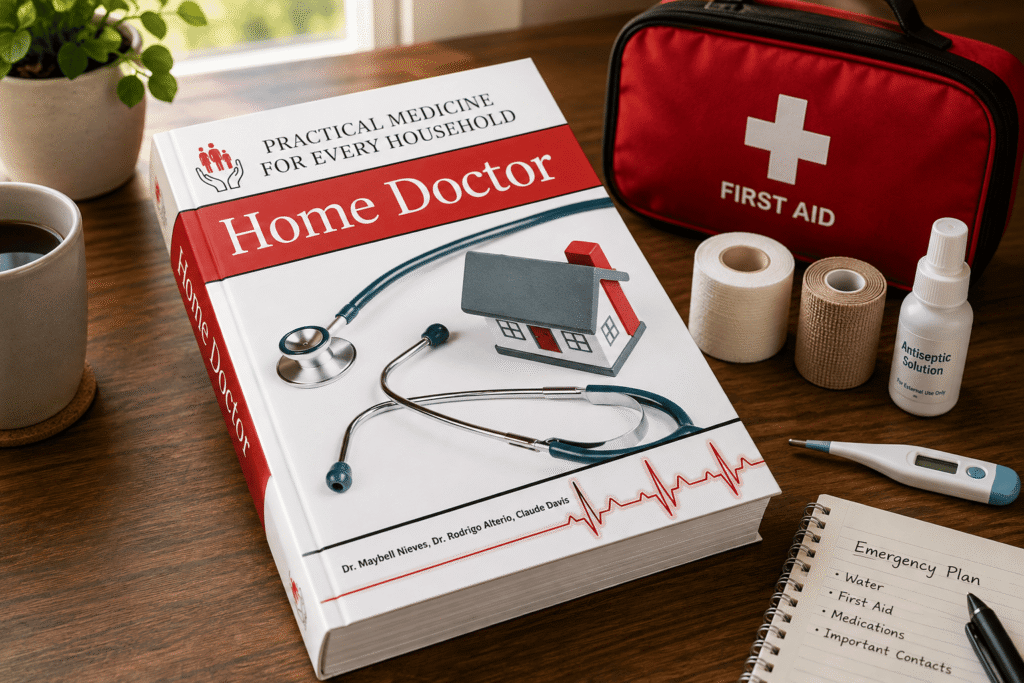
That’s one of the reasons I like the idea behind Home Doctor: Practical Medicine for Every Household.
The book is designed as a practical reference rather than simply a collection of medical definitions. According to its official page, it is more than 300 pages and includes diagrams, practical information, and step-by-step guidance covering a wide variety of household health situations.
A Real-Life Situation Most Families Can Relate To
Picture this.
It’s around 11:30 at night.
Everyone is getting ready for bed when someone in the kitchen accidentally touches a hot pan. It isn’t obviously life-threatening, but the person is in pain and everyone suddenly starts talking at once.
“Put ice on it.”
“No, don’t put ice on it.”
“Use toothpaste.”
“Get the burn cream.”
“Should we go to the hospital?”
This is the kind of situation where panic can make a relatively straightforward problem feel much bigger.
And I think that’s one of the biggest benefits of preparedness: you don’t have to make every decision from scratch.
If your family already has a first-aid kit and a trusted medical reference, you can slow down, assess what happened, and follow appropriate first-aid guidance while deciding whether professional medical attention is necessary.
That is much better than five people standing around a kitchen arguing over something they vaguely remember hearing years ago.
What You’ll Find Inside Home Doctor
One of the things that caught my attention about this particular book is the range of subjects it covers.
The official Home Doctor book page describes sections dealing with skin injuries, burns, wounds, respiratory problems, dental problems, abdominal pain, migraines, heart-related warning signs, stroke recognition, medication issues, and other situations.
That variety matters.
A medical emergency doesn’t always look like the classic emergency-room scenario.
Sometimes it starts with something incredibly ordinary.
A twisted ankle.
A cut finger.
A painful tooth.
A nasty insect bite.
A sudden fever.
A stubborn headache.
A burn from cooking.
A wound that needs proper cleaning.
The Home Doctor book also includes information about recognizing potentially serious symptoms, including warning signs associated with heart attacks and strokes.
Of course, when someone is experiencing potentially life-threatening symptoms, the right response is to seek emergency medical care immediately. A reference book should help you recognize when something may be serious—not encourage you to delay professional treatment.
That distinction is extremely important.
The Most Valuable Thing May Be Knowing When NOT to Treat Something at Home
This is something I think gets overlooked in the whole preparedness conversation.
Being prepared doesn’t mean trying to treat everything yourself.
Sometimes the smartest thing you can do is recognize that a situation requires professional help.
For example, severe chest pain, difficulty breathing, signs of stroke, uncontrolled bleeding, severe allergic reactions, loss of consciousness, or other serious symptoms should be treated as emergencies.
The value of a Home Doctor reference isn’t that it turns an ordinary person into a physician.
It gives you information that can help you understand situations, organize your supplies, apply appropriate basic first aid, and recognize when you should stop trying to manage something yourself and seek medical attention.
That can be an important distinction.
Why Physical Medical Reference Books Still Have a Place
I love having information on my phone.
But there’s something reassuring about having important information available without depending entirely on technology.
Imagine a prolonged power outage.
Your phone battery is at 12%.
Your internet connection is unreliable.
You can’t easily search through websites.
That’s not the ideal time to realize you never learned where your first-aid information is.
A physical copy of a medical reference books like Home Doctor can sit on the same shelf as your first-aid kit, emergency supplies, flashlights, batteries, and other preparedness equipment.
You don’t need to read every page tonight.
Instead, you can gradually familiarize yourself with the sections most relevant to your household.
Parents might want to understand basic injury and fever information.
Someone who spends a lot of time outdoors might pay more attention to bites, stings, wounds, and injuries.
Older family members may have different concerns.
And anyone responsible for children should have a clear understanding of when an illness or injury requires professional evaluation.
Preparing a Home Medical Kit Is Only Half the Job
A lot of people buy a first-aid kit and consider themselves prepared.
I used to think that way too.
But having supplies and knowing how to use them are two different things.
You can have bandages without knowing how to properly handle a wound.
You can have antiseptic supplies without understanding when an injury needs professional attention.
You can have a thermometer without knowing what other symptoms matter.
You can have pain medication without understanding contraindications, interactions, or when pain may indicate something more serious.
Preparation works best when knowledge and supplies go together.
That’s why I recommend thinking about your medical preparedness in three layers:
Layer 1: Supplies.
Keep a sensible first-aid and medical kit at home.
Layer 2: Knowledge.
Learn basic first aid and familiarize yourself with reliable medical information.
Layer 3: Decision-making.
Know the warning signs that mean you should contact a healthcare professional or seek emergency care.
The Home Doctor concept fits naturally into that second layer.
A Book You Can Explore Before You Actually Need It
One mistake people make with emergency preparation is waiting until something goes wrong.
That’s backwards.
You don’t buy a flashlight during a blackout.
You don’t learn where your emergency water is after the water supply stops.
And you shouldn’t open your medical reference for the first time while someone is standing in front of you with an injury.
Spend a quiet weekend going through it.
Mark the sections that seem particularly relevant to your family.
Keep it somewhere accessible.
Make sure the people in your household know where it is.
You might even create a small “medical preparedness” shelf containing your first-aid supplies, thermometer, basic medical equipment, important medication information, and reference materials.
That way, everything is together with the Home Doctor book.
What I Like About the Home Doctor Approach
The official description emphasizes practical information rather than simply discussing medical theory. It was written with input from doctors, including Dr. Maybell Nieves and Dr. Rodrigo Alterio, and draws heavily on experiences involving healthcare shortages and difficult circumstances in Venezuela.
That background is interesting because it approaches preparedness from a slightly different angle.
We normally think about healthcare as something that is always available.
But what happens when it isn’t?
That doesn’t necessarily mean society has collapsed.
A local pharmacy could close early.
A storm could make roads dangerous.
A power outage could affect services.
A natural disaster could overwhelm local healthcare facilities.
An ordinary family can encounter temporary disruptions without experiencing some dramatic apocalyptic scenario.
And that’s precisely why practical preparedness makes sense.
Don’t Wait for an Emergency to Build Your Medical Knowledge
Here’s the uncomfortable truth:
Most of us don’t know nearly as much about basic medical care as we think we do.
We recognize a few obvious things.
We know that serious bleeding is bad.
We know that broken bones hurt.
We know that chest pain can be dangerous.
But there are many less obvious situations where knowing what to look for can make a difference.
That’s why I think the best approach is not to become obsessed with every possible disaster.
Instead, build a calm, practical level of preparedness.
Learn basic first aid.
Keep essential supplies available.
Know your family’s medications and important medical information.
Have emergency contact numbers accessible.
Understand the warning signs that require professional care.
And keep a reliable reference nearby.
That’s a much more sensible approach than constantly worrying about worst-case scenarios.
Could Home Doctor Be Worth Adding to Your Preparedness Shelf?
If you’re already building a home emergency kit, I’d seriously consider adding a dedicated medical reference to it.
The Home Doctor book currently presents itself as a 300+ page practical guide with diagrams and instructions covering a wide variety of household medical topics. The official page also lists additional digital resources and a 60-day money-back guarantee.
You can look through the details and decide whether it fits your family’s needs here:
Check out Home Doctor: Practical Medicine for Every Household
I wouldn’t buy it because you expect some disaster to happen tomorrow.
I’d buy it for the same reason I’d keep a properly stocked first-aid kit.
Because preparation is much easier when you’re not under pressure.
One Final Thought
There’s a phrase I really like when it comes to preparedness:
Prepare without panicking.
You don’t need to turn your home into a bunker.
You don’t need to become a medical professional.
And you certainly shouldn’t attempt to replace qualified healthcare with a book.
What you can do is become a little more capable.
You can learn basic first aid.
You can organize your medical supplies.
You can learn which symptoms shouldn’t be ignored.
You can keep important information close at hand.
And you can give yourself and your family a better chance of responding calmly when something unexpected happens.
For me, that’s the real value of a Home Doctor reference.
It’s not about pretending you can handle everything yourself.
It’s about being prepared enough to know what you can handle, what you shouldn’t attempt, and what you need to do while professional help is on the way.
And honestly, that’s a pretty useful skill for any household.
Medical Disclaimer
This article is for general educational and preparedness purposes only. It is not medical advice and does not replace a qualified doctor, pharmacist, dentist, emergency service, or other healthcare professional. Do not delay professional medical care because of information found in this article or any book. For symptoms that may indicate a serious or life-threatening condition, seek appropriate emergency medical assistance immediately. Always follow the directions of healthcare professionals and medication labels, and consider your individual medical conditions, allergies, age, pregnancy status, and medications before using any treatment.
Affiliate Disclosure
Some links in this article may be affiliate links. If you purchase through an affiliate link, we may receive a commission at no additional cost to you. We only recommend products that we believe may be useful for readers interested in practical household preparedness.
Leave a Reply